
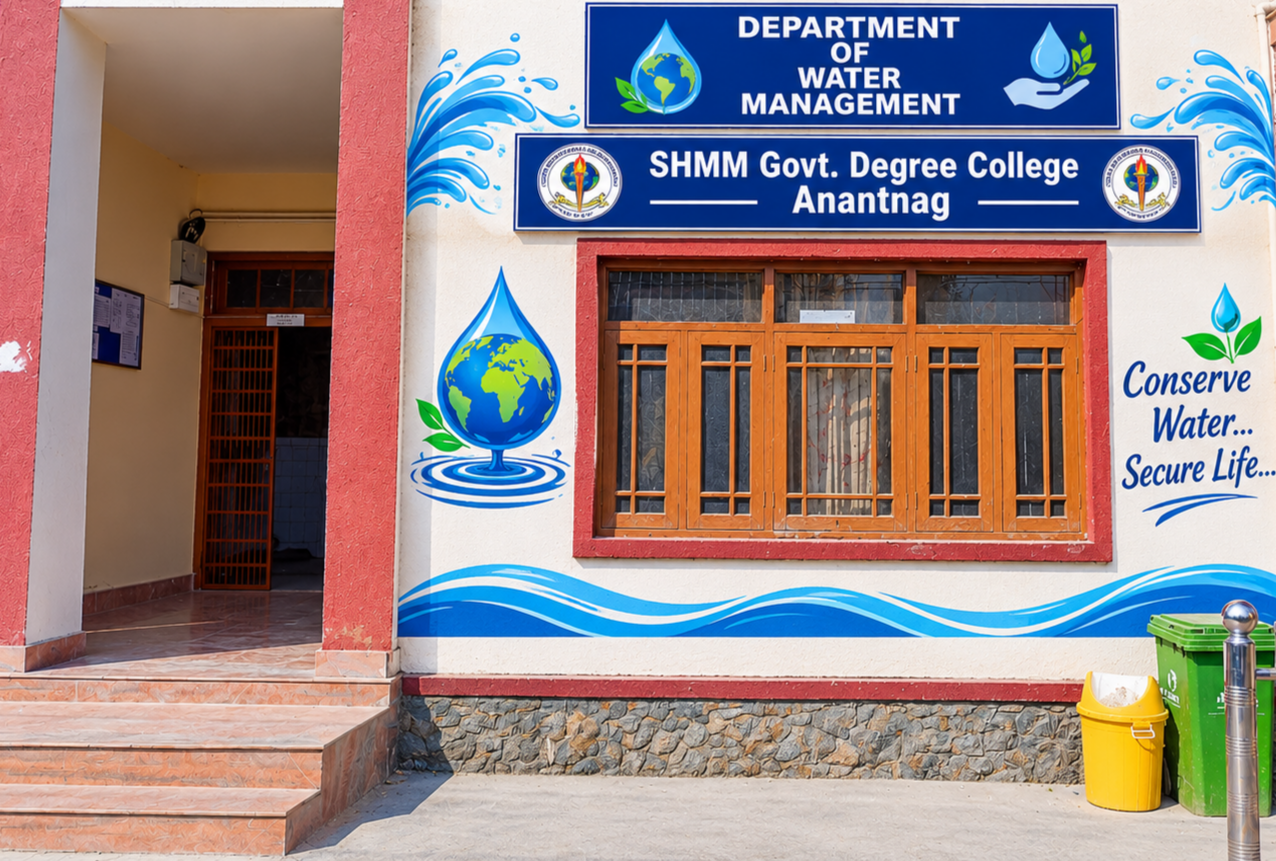
Water, the elixir of life has evolved to be the most diversified resource in the modern growth story. This has set the platform for dedicated scientific study and research of this diversified resource. It gives me great pleasure to welcome you to the Department of Water Management, GDC Anantnag, which is actively engaged in the research and education in the different aspects of the field of Water Management. This is a unique department of its kind in India dedicated to research and education singularly in the field of Management of water resources. Putting into perspective the dynamic nature of challenges in the water resources sector and the additional pressure induced by the impacts of climate change, the specialized training in the water management of under graduate students from science background opens up a vista of opportunities for the students and at the same time provides the nation with the much needed highly skilled human resource. The Department offers Water Management as Major, Minor and Multidisciplinary courses for UG program (NEP 2020) - HOD's Message
The Department of Water Management and the degree program seek to prepare students to solve water issues. The Bachelor of Science in Water Management, a program that is one of the first of its kind in the nation, will educate students in the interrelationships of the technical, social, political, and economic aspects of the field. The objective of the program is to provide students with educational skills and background necessary for the positions in water resources management in private industry, government, and nongovernmental organizations. Water resources management is intertwined with the environmental field and the curriculum will offer courses that will enable students to gain a background in this field as well. The program responds to the critical need for water resource professionals who have an understanding of all phases of water resource management within the agriculture and municipal sectors. The professionals will help to identify the most effective solutions to water resources management problems, involving both technical and non-technical aspects. The curriculum will emphasize subjects such as soil and water conservation, water chemistry, streams and lakes and urban water problems.
The Department of Water Management is in its infancy stage with well established Faculty room and Laboratory. Besides, a rich collection of foreign and India authored books, magazines and journals are available in the college library for the students.
The objectives are to:
Promote sustainable utilization, conservation and management of surface water and groundwater resources.
Equip students with practical skills in water sampling, laboratory analysis and water quality testing.
Create awareness about water-related environmental challenges, climate change and aquatic ecosystem conservation.
Promote research, innovation and the application of modern technologies in water management.
Develop an understanding of water governance, policies, legislation and integrated water resources management.
Familiarize students with national and international initiatives, particularly Sustainable Development Goal 6 (Clean Water and Sanitation).
Prepare students for higher education, research and career opportunities in water management and allied environmental sectors.
Water Management is an interdisciplinary subject that encompasses the scientific, technical, environmental, social and economic aspects of water resources. It deals with the study, conservation, development, distribution and sustainable utilization of water. The subject provides knowledge about water quality assessment, water pollution control, watershed management, hydrology, groundwater resources, wastewater treatment, water governance, water conservation technologies and integrated water resources management. It also explores emerging areas such as smart water management, GIS and remote sensing, climate change impacts and sustainable water infrastructure. The subject offers diverse career opportunities in research, education, environmental consultancy, water quality laboratories, government departments, NGOs and water supply and sanitation sectors.