
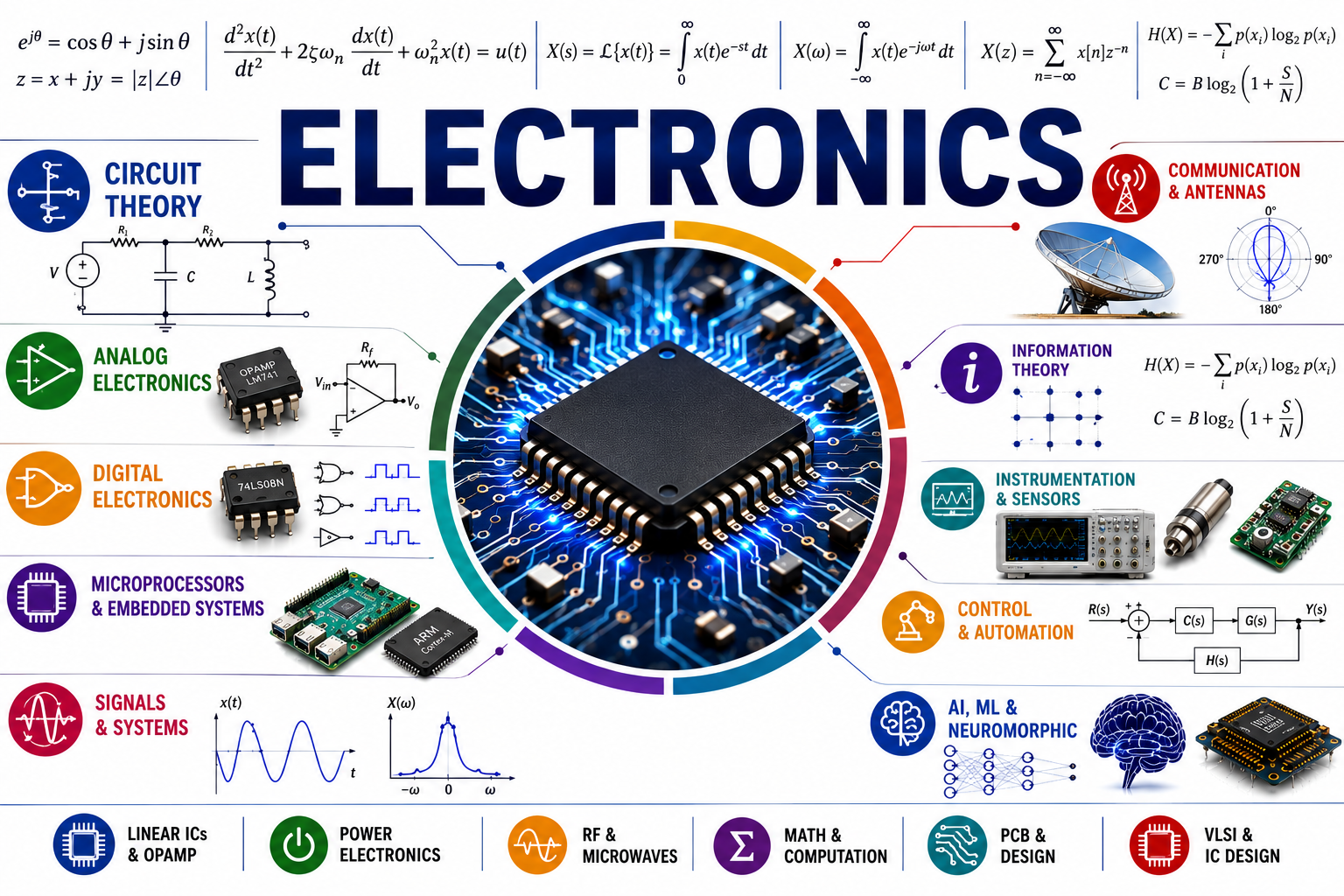
Established in 1982, the Department of Electronics is one of the pioneering science departments of Government Degree College (Boys), Anantnag. For over four decades, the department has been committed to quality education through a balanced integration of theoretical foundations, practical laboratory training, innovation, and research-oriented learning.
In accordance with the National Education Policy (NEP 2020), the department offers Electronics as a Major, Minor, Multidisciplinary (MD), and Skill Enhancement Course (SEC). The curriculum spans fundamental areas such as circuit theory, semiconductor devices, analog and digital electronics, signals and systems, applied mathematics, communication, microprocessors, and instrumentation, while progressively engaging students with emerging fields including VLSI, Internet of Things (IoT), and artificial intelligence.
Supported by experienced faculty, well-equipped laboratories, smart classrooms, and outcome-based teaching practices, the department aims to develop technically competent, innovative, and socially responsible graduates.
Beyond the classroom, students are encouraged to participate in hands-on projects, workshops, seminars, industrial visits, innovation competitions, and entrepreneurship activities, preparing them for higher education, research, industry, public service, and emerging technology careers.
Electronics is at the heart of modern technology. It enables advancements in communication, computing, healthcare, automation, artificial intelligence, transportation, energy, and space technology. It also provides the foundation for the intelligent and connected systems shaping the modern world.
The department provides a modern academic and practical learning environment with:
|
- To provide strong theoretical and practical foundations in Electronics.
- To develop analytical, problem-solving, and technical skills.
- To promote innovation, research aptitude, and interdisciplinary learning.
- To prepare students for higher education, employment, entrepreneurship, and emerging technologies.
- To foster professional ethics, creativity, teamwork, and lifelong learning.
Electronics is one of the fastest-growing disciplines that forms the foundation of modern technological development. Graduates in Electronics have excellent opportunities in:
- Electronics Fabrication Industry
- Semiconductor Industry
- Telecommunications
- Embedded Systems
- Internet of Things (IoT)
- Artificial Intelligence Hardware
- Robotics and Automation
- Consumer Electronics
- Medical Electronics
- Renewable Energy Systems
- Defence and Space Research
- Government Technical Services
- Higher Education and Research
- Entrepreneurship and Start-ups
Students can pursue higher studies including:
- M.Sc. Electronics
- M.Tech.
- Integrated Ph.D.
- Ph.D.
- Interdisciplinary Research in Electronics, AI, Robotics, Communication Engineering, and Semiconductor Technology.
Since its establishment in 1982, the Department of Electronics has contributed significantly to teaching, research, innovation, and technology-oriented education at the college. Major achievements include:
- More than four decades of undergraduate teaching and laboratory education in Electronics.
- Implementation of NEP 2020 programmes through Major, Minor, Multidisciplinary, and Skill Enhancement courses.
- Development of modern laboratory and smart-classroom facilities for experiential learning.
- Research publications in reputed national and international journals and conferences.
- Contributions to innovation and intellectual property through research and patent activities.
- Organization of and participation in seminars, workshops, conferences, technical events, and faculty development activities.
- Promotion of student exposure through projects, industrial visits, competitions, and technology-oriented activities.
- Development and proposal of contemporary courses aligned with emerging technologies and national educational priorities.
- Continued contribution to interdisciplinary education connecting Electronics with AI, healthcare, sensing, communication, and sustainable technologies.