
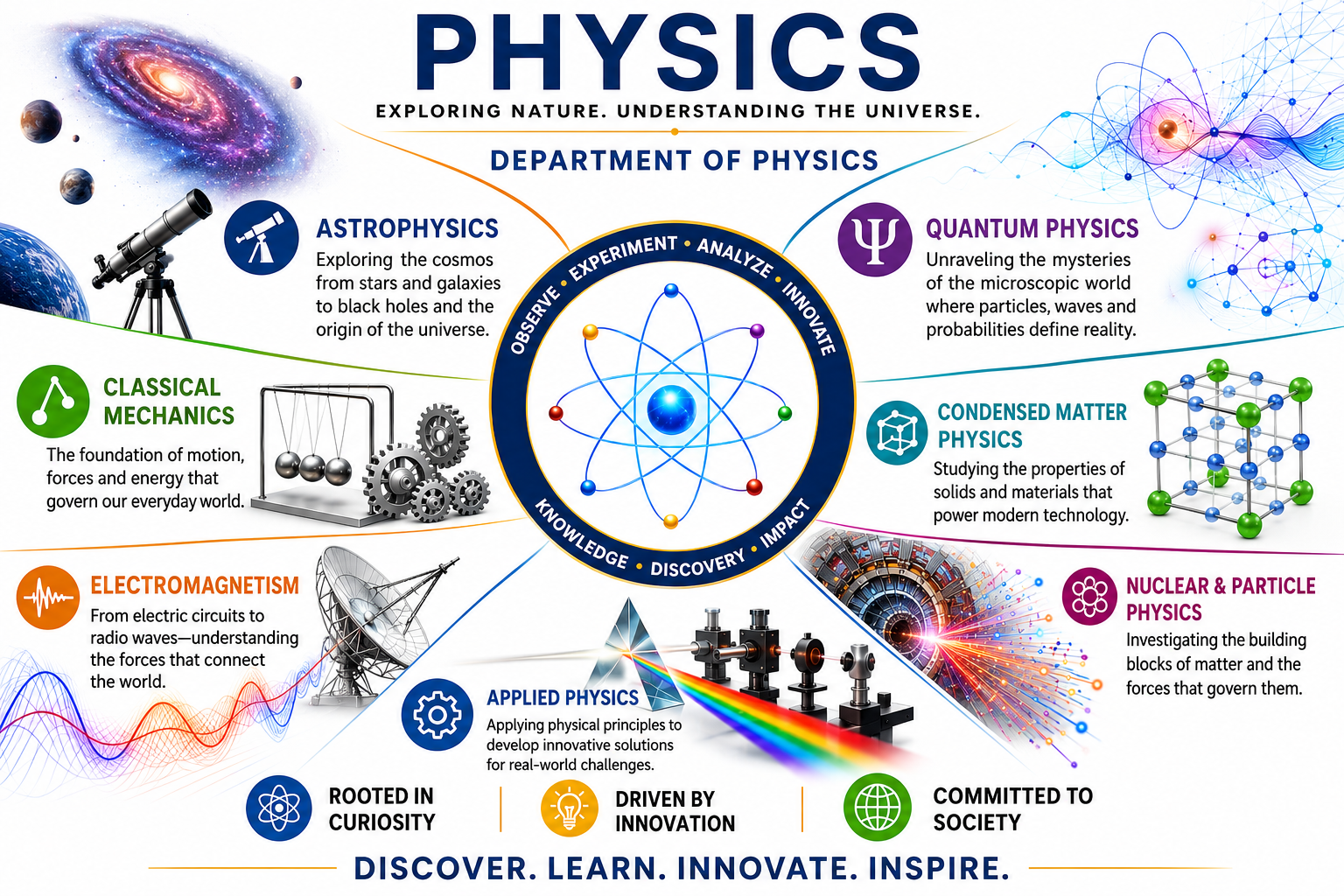
The Department of Physics at Government Degree College, Anantnag, established in 1965, is one of the oldest and most distinguished academic units of the institution. As an early stakeholder in the college’s academic journey, the department has played a pivotal role in advancing science education, nurturing scientific temper, and promoting research‑oriented learning.
Over the decades, the department has produced generations of students who have excelled in diverse fields of science and technology. It offers undergraduate programs with a strong emphasis on both theoretical foundations and experimental training. The curriculum spans the core areas of physics—Classical Mechanics, Electrodynamics, Quantum Mechanics, Statistical Mechanics, Thermodynamics, Condensed Matter Physics, Nuclear and Particle Physics, Optics, Solid State Physics, and Electronics—while also extending into emerging interdisciplinary domains such as Nanotechnology, Biophysics, Information Physics, and Computational Physics.
Aligned with the National Education Policy (NEP‑2020), the department has introduced a flexible and multidisciplinary curriculum designed to integrate skill‑based learning, digital resources, and research opportunities. This new framework ensures that students are equipped not only with subject knowledge but also with competencies relevant to contemporary scientific and technological challenges.
To support hands‑on learning, the department maintains three experimental teaching laboratories, a dedicated dark room for optics experiments, and a smart classroom equipped for multimedia instruction. Faculty members are actively engaged in research, publishing in reputed national and international journals, and securing competitive grants. Notable achievements include projects funded by the Science and Engineering Research Board (SERB) and IUAC, New Delhi, as well as international collaborations .
With its long history of academic excellence, modernized curriculum, and dedicated faculty, the Department of Physics continues to serve as a vibrant hub of education, research, and innovation—preparing students to contribute meaningfully to academia, industry, and society.
Vision
To be a leading center of physics education and research in the region, fostering scientific inquiry, innovation, and interdisciplinary collaboration. The department envisions preparing students with strong theoretical foundations, practical skills, and research aptitude to contribute meaningfully to academia, industry, and society.
Mission
- To provide high-quality undergraduate education in physics through a balanced integration of theory, experimentation, and modern technology.
- To cultivate a research-oriented culture by engaging faculty and students in projects, seminars, and collaborations with national institutions.
- To nurture scientific temper, critical thinking, and problem-solving skills among students.
- To continuously upgrade laboratories, digital resources, and teaching methodologies in line with emerging scientific advancements.
- To build partnerships with industry and research organizations, creating pathways for internships, higher studies, and professional careers.
- To contribute to community outreach by promoting science awareness and encouraging young learners to pursue physics.
To support hands-on learning, the department maintains:
- Three experimental teaching laboratories
- A dedicated dark room for optics experiments
- One smart classroom equipped for multimedia instruction
These facilities underpin laboratory courses, student projects, and demonstrations, ensuring a rich undergraduate learning experience.
The Department of Physics at Government Degree College, Anantnag pursues the following objectives:
- Academic Excellence: To deliver rigorous undergraduate education in physics, integrating theoretical knowledge with experimental practice.
- Research Promotion: To encourage faculty and student participation in research projects, publications, and collaborations with national and international institutions.
- Skill Development: To cultivate analytical thinking, problem‑solving abilities, and scientific temper among students.
- Infrastructure Enhancement: To continuously upgrade laboratories, classrooms, and digital resources in line with modern scientific advancements.
- Interdisciplinary Growth: To expand into emerging fields such as nanotechnology, biophysics, and information physics, fostering cross‑disciplinary learning.
- Student Empowerment: To provide structured opportunities for seminars, projects, internships, and higher studies, preparing students for diverse career pathways.
- Community Engagement: To contribute to science outreach programs, promoting awareness and inspiring younger generations to pursue physics.
The Department of Physics at Government Degree College, Anantnag operates as a core academic unit dedicated to undergraduate physics education, research, and community engagement. Its scope encompasses:
- Academic Programs: Delivering comprehensive undergraduate courses in physics, covering classical, modern, and applied domains, with emphasis on both theoretical foundations and experimental practice.
- Laboratory Training: Providing hands-on learning through well-equipped laboratories, including specialized facilities for optics and multimedia-based instruction.
- Research and Innovation: Encouraging faculty and student participation in research projects, publications, and collaborations with national institutions, supported by competitive grants and external funding.
- Interdisciplinary Integration: Extending physics education into emerging fields such as nanotechnology, biophysics, and information physics, fostering cross-disciplinary learning.
- Student Development: Promoting seminars, project presentations, and undergraduate research opportunities to build critical thinking, problem-solving, and scientific inquiry skills.
- Community Outreach: Advancing science awareness and contributing to regional academic development through workshops, collaborations, and alumni engagement.
- Future Growth: Expanding digital resources, modernizing infrastructure, and strengthening partnerships with industry and research organizations to create pathways for higher studies, internships, and professional careers.
Faculty members of the Department of Physics are actively engaged in research and scholarly dissemination. They regularly publish in reputed national and international journals and present their work at conferences and seminars, contributing to the department’s vibrant academic culture.
Notable funded and collaborative projects include:
- Prof. Arshad Masoodi – Worked at CERN (European Organization for Nuclear Research) and has published influential papers in high‑impact journals.
- Dr. Riyaz – Recipient of a research grant from the Science and Engineering Research Board (SERB).
Dr. Abida – Successfully completed a project funded by IUAC, New Delhi.